Page 2 of 3
Posted: Sun Nov 25, 2007 9:20 am
by Eliot
mgbv8 wrote:Can someone show me a picture of a die grinder please. I've done a bit of polishing on mine with the big dremmel, and I've used the carbide paper on small drums. The knobbly stone things I have just clog up every ten seconds.
I've got 4 spare heads I want to practice on over the winter.
Ta
Perry
Never seen before shot, consider yourself honoured:
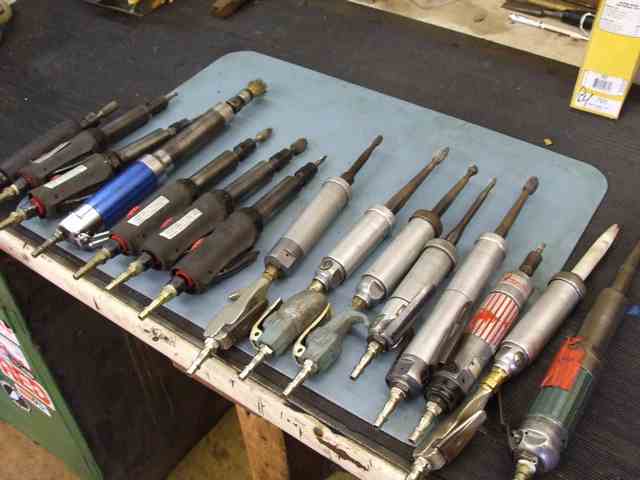
On the left, was the collection i started with modern long reach grinders - the right is the ones my dad developed over the years. Upshot - is that you want long reach - and toss the stupid saftey lockout catch as far as you can throw it.

He also had hoses attached to each one, but I swapped them for PCL's as I dont use them every single day like he did.
Posted: Sun Nov 25, 2007 10:29 am
by Darkspeed
WOW

- "Kid in a sweet shop look....."
[/quote]
Never seen before shot, consider yourself honoured:
[/quote]
My next job is building an acoustic enclosure for the compressor - bit underrated so runs out of puff and has to motor continuously.
Thanks for the insights Eliot
Cheers
Andrew
Posted: Sun Nov 25, 2007 1:56 pm
by mgbv8
OK
I thought a die grinder was a tool bit. My big dremmel will do the same job.
Its those burr tools I need then.
Thanks
Posted: Sun Nov 25, 2007 4:08 pm
by Darkspeed
The only drawback with Dremel type tools is that if the tool bit jams then the motor overloads whereas an air tool just stalls. Just means that you have to take a bit more care.
Andrew
Posted: Sun Nov 25, 2007 4:57 pm
by katanaman
Getting bits for a dremel will be a problem as well as they use a very small shank where the normal size is 1/4". You can get dremel bits as I have some but they are very small and would take ages to port a head with.
Posted: Sun Nov 25, 2007 6:14 pm
by mgbv8
My dremmel is the 250watt motor with a flexi drive to quite a compact tool head. The chuck is small though. I have a foot pedal to control the speed so its not a bad little unit once you get used to. But I think I'll get an air powered one. Anither excuse to add to the air tools collection eh?
Thanks for the pics.
Posted: Sun Nov 25, 2007 10:08 pm
by Eliot
Once you start getting into your air tools - you quickly realise that the cheap direct drive things are only any good for pumping the kids paddling pool up with.
A 1/2" impact wrench chews the air in short order.
Posted: Mon Nov 26, 2007 6:34 am
by minorv8
Having cut a few heads myself (both cast iron and aluminium) I have to say that a Dremel is a toy. It may be useful when doing finishing touches for the chamber but any major cutting required proper tools. Remember also that aluminium requires different profile for the bits, steel bits will clog in no time. If you can, try to find bits with longer shanks, something like these:
http://store.summitracing.com/partdetai ... toview=sku. Rover heads have longish ports and normal shank bits won´t get anywhere near the interesting area.
Posted: Mon Nov 26, 2007 3:43 pm
by Darkspeed
The long shank bits and collet extensions look very useful tools - I may risk ordering a few bits from Carbidebur.com in the US.
I am also looking at the DIY flow bench articles and the like and fancy giving one of those projects a go.
Anyone got any thoughts about how short I can go with the guides - I have seen quite a few heads modified to reduce the guide length to about 45mm if this is reasonable it means I can take quite a lot of the length that protrudes into the port out and that gives good access to the port area around the guide boss.
Edit.
The guide is some 66.5mm long and the protrusion into the port is 16mm so taking the guide down to the boss leaves a length of 50mm which should be more than adequate and then gives good access for further easy material removal in the port.
Cheers
Andrew
Posted: Mon Nov 26, 2007 5:17 pm
by Eliot
You can score them off ebay easily:
search: "tungsten carbide burr"
plain carbide burrs wear out quicker.
Posted: Mon Nov 26, 2007 5:56 pm
by Darkspeed
Eliot wrote:You can score them off ebay easily:
search: "tungsten carbide burr"
plain carbide burrs wear out quicker.
I don't think I have ever seen the long shank versions or extensions on e-bay though. - Anyone seen these in the UK at a decent price?
Andrew
Posted: Mon Nov 26, 2007 6:24 pm
by Wotland
Hello,
Myself I use Metabo Electronic Straight Grinder GE 700 with flexible shaft
http://www.metabo.com/metabo/com/en/pro ... 03_00.html
Not cheap, it is professional electric grinder tool. You can use with it all types of carbide burr/stones/abrasive tools with 6mm shanks.
Posted: Mon Nov 26, 2007 11:21 pm
by Darkspeed
Well I have run the figures for a standard 40mm valve port and I come up with a port that should have
A seat ID of 36mm - opening out to 38.8mm about 25 mm from the seat then reducing back to 34mm over another 25 mm then straight for 70mm then tapering out.
What I am struggling to find at the moment is an easy equivalence to use for the rectangular port dimension.
The rectangular port needs to have the equivalent flow capacity of a 34mm dia port - My Bell book states rather oddly that as the rectangular port does not flow as well as a round port that the port area should be 0.67 of the valve area. However the round port is calculated at 0.82 of the valve diameter.
I can only assume that its a printing error and perhaps the printer put the number in upside down and that it should be 0.97 of the valve dia.
This being 18% greater in area rather than 18% less.
Any thoughts before I go trawling through the loft for my flow in ducts books.
Valve area is 1256mm2
1256 x .82 = 1030mm2
1256 x .67 = 841mm2
1256 x .97 = 1218mm2
Stock inlet port at port face is - 38 x 24 = 912mm2
Maximum increase looks to be - 44 x 27= 1188mm2
This does seem to stack up with the notion that even with big valves the ports cant actually flow enough to feed them.
I need to do a bit more digging about - any thoughts - sorry if all this has been covered before.
Andrew
Edit.
Having read the book again not tired and with plenty of lemsip to fight the head cold. I have noted the change in units - One expressed in diameter and the other in area.
However it still does not seem to follow logic if the square port flow is not as good as the round port due to the addition surface area
0.67 of the valve area is 841mm2
0.82 of the valve diameter at 32.8 mm is an equiv area of 845mm2
So about the same figure when expressed as a CSA
My old duct flow calc basically says that for a square duct the equiv round duct is Diameter is the same as length of a side.
32.8mm Diameter is 845mm2
32.8 sq = 1075mm2
1075 is .856 of the Valve area
sqroot of 841mm2 is 29mm
Help.
Posted: Wed Nov 28, 2007 4:31 pm
by Darkspeed

Found it - Vizard uses a figure of + 10% on CSA of a round port to compensate for square ports.
845 x 1.1 = 930mm2
Which is 0.74 of the valve CSA - makes me wonder if the Bell figure should have been 0.76 of valve area rather than 0.67 - whatever it may have been 10% is a nice easy number to remember.
Cheers
Andrew
Posted: Thu Nov 29, 2007 2:13 am
by CastleMGBV8
Andrew,
Thanks for your findings and intended mods to your heads, it's making an interesting read.
I was interested in the before and potential after dimensions for the 3.5 Rover ports, I have a pair of Alloy Buick 300 heads and they are as standard 45mm x 25mm with 1.7" inlets and 1.33 Exhaust valves. I am intending to just give the the ports a light clean up, open up the throats behind the seats and have new unleaded seats for the exhaust and up the exhaust valve to 1.4" fit bulleted guides with a view to fitting the heads on a 4.3 which should make for an interesting engine
The heads have large 54cc combustion chambers so will require flat top pistons to achieve a compression ratio of approx 10-1
Keep your progress reports coming, they will make interesting reading.
Kevin.